
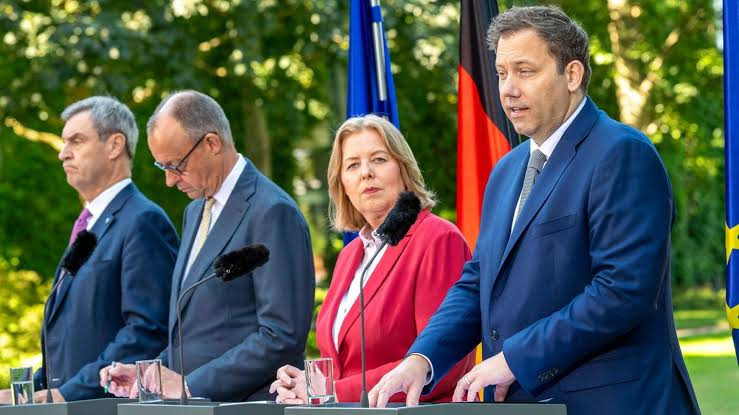
Germany's proposed pension reforms have returned to the centre of a growing political dispute after regional election setbacks increased pressure on Chancellor Friedrich Merz and intensified calls for changes to his government's social-policy agenda.
The debate has become particularly significant following elections in Mecklenburg-Western Pomerania and Berlin. Merz's Christian Democratic Union suffered a historic setback in Mecklenburg-Western Pomerania, falling below the threshold required for representation in the state parliament, while also losing ground in Berlin.
Mecklenburg-Western Pomerania's SPD state premier Manuela Schwesig has argued that the federal government cannot simply continue on its previous course following the electoral results. One of her strongest objections concerns proposals affecting Germany's pension system.
The disagreement places pensions at the heart of a broader question confronting Merz's coalition: whether to press ahead with difficult structural reforms despite political resistance or revise elements of the programme in response to public and regional concerns.
Schwesig Pushes Back Against Pension Changes
A central point of disagreement concerns Germany's system allowing people with particularly long contribution histories to retire without deductions before the standard retirement age.
The benefit is commonly referred to as the “Rente mit 63”, although the actual qualifying age has gradually increased and can now be higher depending on a person's year of birth.
Schwesig has strongly opposed abolishing the deduction-free pension available after 45 years of qualifying contributions. She has argued that the change would disproportionately affect people in eastern Germany, where long employment histories are relatively common and many retirees rely heavily on the statutory pension system.
Her opposition predates the latest election results.
Earlier this year, Schwesig rejected the idea that all recommendations from the government's pension commission should automatically be implemented without further negotiation. She argued that the proposals needed discussion with Germany's states, social partners and people directly affected by the reforms.
The resistance is not confined to the SPD.
CDU state leaders in eastern Germany have also challenged the planned changes. Saxony's state premier Michael Kretschmer has warned that pension and care reforms could face opposition in the Bundesrat unless modifications are made.
That cross-party regional resistance complicates the debate for Merz because it demonstrates that objections to the pension package cannot be reduced to a straightforward confrontation between the governing parties.
Merz Wants Structural Reform to Continue
Merz has taken a different position, arguing that Germany needs substantial changes to make its retirement system sustainable as the population ages.
The chancellor previously described the recommendations of the government's pension commission as an important step towards restructuring Germany's retirement system and called for legislation to move through parliament before the end of 2026.
Among the government's broader ideas is greater use of capital markets within retirement provision, alongside measures intended to encourage people to remain in employment longer.
Merz has also supported ending incentives for early retirement. In August, he reiterated that position despite objections from eastern German state leaders.
The economic challenge underlying the argument is substantial.
Germany has to finance pensions for an ageing population while maintaining contribution levels that remain manageable for workers and employers. The government also faces slower economic growth, demographic pressures and shortages of skilled workers.
At the same time, pension changes can have immediate political consequences because they affect millions of current workers and retirees.
Germany has already legislated to keep its pension level at 48% until 2031. The unresolved question is what happens after that guarantee expires, when demographic pressures could lead to higher contributions, lower relative pension benefits or additional government financing requirements.
Election Results Increase Pressure on the Coalition
The pension argument has become more politically sensitive because it follows a series of difficult regional elections for Merz's CDU.
In Mecklenburg-Western Pomerania, the Alternative for Germany finished first while the CDU recorded its worst postwar result in the state and failed to clear the 5% threshold for parliamentary representation. In Berlin, the CDU also lost ground.
Merz has nevertheless indicated that he intends to remain chancellor and CDU leader and continue pursuing reforms.
The results have intensified debate over whether the federal government's reform programme is contributing to voter dissatisfaction.
There is evidence that social policy is weighing heavily on voters. An Infratest dimap survey conducted around the earlier Saxony-Anhalt election found social security was the most frequently cited decisive issue among respondents. In that survey, 59% said the government should make corrections to its planned pension and healthcare reforms, compared with 13% who favoured implementing them as planned. Those figures relate specifically to that election-period survey and should not be treated as a current nationwide poll.
The results nevertheless help explain why pensions have become such a politically sensitive issue for both parties in the governing coalition.
For the SPD, protecting retirement benefits remains closely connected to its traditional social-policy identity. For the CDU, the challenge is balancing those concerns against its argument that Germany's ageing population requires structural change.
The disagreement therefore extends beyond one retirement provision.
It raises a larger question over how much of the government's reform programme can survive unchanged after a series of electoral setbacks.
Merz has so far signalled that he intends to continue pursuing reforms. Schwesig and other regional leaders are making clear that some of the most controversial proposals will face resistance.
With the government aiming to advance pension legislation before the end of the year, the next negotiations will determine whether Germany receives the sweeping reform Merz originally envisaged or a substantially revised compromise.