
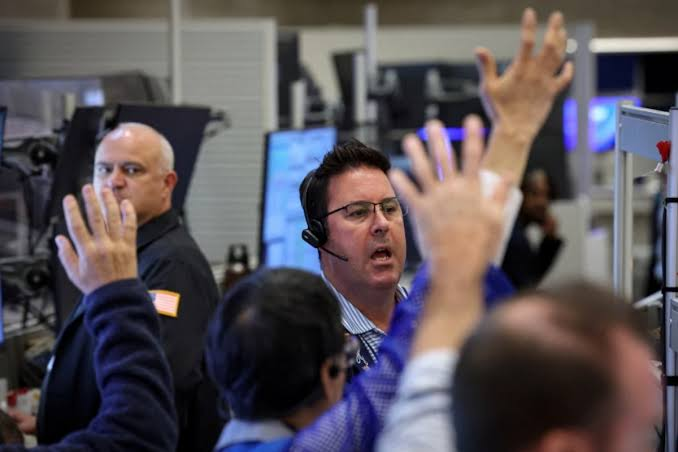
Global investors have pulled billions of dollars from stock funds as higher oil prices, persistent inflation and rising interest rates force markets to reassess risk.
Investors withdrew a net $23.21 billion from global equity funds during the week through September 16, according to LSEG Lipper data reported by Reuters. It was the largest weekly withdrawal since December 17, 2025.
The scale of the movement provides a snapshot of how quickly investor behaviour can change when inflation and borrowing costs begin moving in the wrong direction.
$23.21 Billion Leaves Global Equity Funds
The headline number is significant.
A net $23.21 billion flowed out of global stock funds during the reporting week, marking the largest weekly withdrawal in approximately nine months.
Fund-flow data does not mean investors collectively sold $23 billion of stocks outright. It measures money entering and leaving investment funds.
But it is still a useful indicator of investor sentiment.
Large withdrawals can show that investors are becoming less comfortable holding riskier assets under prevailing economic conditions.
This time, energy prices and interest rates appear to be major factors.
US Stock Funds Take the Biggest Hit
The pressure was particularly visible in the United States.
Investors withdrew $31.44 billion from U.S. equity funds, marking their fourth consecutive week of net outflows.
That figure is larger than the global net withdrawal because other regions attracted investment that partially offset the U.S. outflow.
European equity funds recorded approximately $295 million in withdrawals.
Asian equity funds moved in the opposite direction, attracting approximately $6.26 billion.
The regional differences show that investors are not simply abandoning stocks everywhere.
They are also moving capital between markets.
Oil Prices Have Brought Inflation Back Into Focus
One of the biggest reasons for the change in sentiment is oil.
Crude prices climbed to four-month highs during the week, intensifying concerns about inflation.
Oil affects considerably more than the price paid at petrol stations.
Higher energy costs can increase transportation expenses, manufacturing costs, aviation expenses and the cost of moving goods through global supply chains.
Companies can absorb some of those increases.
But when energy remains expensive for an extended period, businesses may eventually pass higher costs on to customers.
That is where energy prices can become an inflation problem.
Higher Inflation Can Mean Higher Interest Rates
Inflation matters to financial markets because central banks use interest rates to try to keep price growth under control.
The U.S. Federal Reserve increased its benchmark interest rate by 25 basis points on September 16 and indicated that additional tightening could be necessary if inflation pressures remain elevated.
That immediately changes the calculation for investors.
Higher interest rates increase borrowing costs across the economy.
Mortgages can become more expensive.
Companies can pay more to refinance debt.
New investment projects become harder to justify.
Consumers may also reduce discretionary spending as financing costs rise.
Treasury Yields Are Adding Pressure
Bond markets are reinforcing the message.
The U.S. 10-year Treasury yield reached around 5% on Friday, its highest level since 2007, according to Reuters.
That matters enormously for equity valuations.
Government bonds are generally considered lower-risk investments than stocks.
When government debt offers significantly higher yields, investors have less incentive to accept equity-market risk unless they expect sufficiently strong returns.
Higher bond yields can therefore create competition for stocks.
They also increase the discount rates investors use when estimating the present value of companies' future earnings.
Growth Stocks Can Be Particularly Sensitive
Companies whose valuations depend heavily on earnings expected many years into the future can be particularly sensitive to higher rates.
This often includes technology and other growth-oriented businesses.
When interest rates rise, the present value assigned to distant future earnings can decline.
That does not automatically mean technology companies perform poorly whenever rates increase.
Corporate earnings, AI investment, productivity and investor expectations all matter too.
But a higher-rate environment changes the valuation equation.
Investors Are Not Abandoning Technology
Interestingly, the fund-flow data shows that investors are still selectively buying certain sectors.
Global equity sector funds attracted approximately $4.49 billion, their strongest inflow in six weeks.
Technology funds attracted about $1.94 billion.
Financial funds received approximately $1.31 billion, while consumer discretionary funds attracted around $621 million.
That distinction matters.
Investors may be reducing broad stock exposure while continuing to put money into industries where they see specific opportunities.
This is less a story of universal panic than one of increasing selectivity.
Government Bonds Are Attracting Money
The bond market shows a similar pattern.
Global bond funds received only around $855 million during the week, the smallest inflow since April.
But investors showed greater interest in safer parts of the bond market.
Government bond funds attracted approximately $2.96 billion, while short-term bond funds received about $1.96 billion.
By contrast, high-yield bond funds suffered around $3.85 billion in withdrawals.
That pattern is consistent with investors becoming more cautious rather than simply abandoning financial markets.
Gold Continues Attracting Investment
Precious metals are also benefiting from uncertainty.
Gold and other precious-metals funds attracted approximately $1.17 billion during the week.
It was their ninth week of inflows during the previous ten weeks.
Gold has historically attracted investors during periods of inflation concerns, geopolitical uncertainty and financial-market volatility.
That does not mean gold always rises during crises.
But strong precious-metals fund flows show that some investors are actively seeking alternatives while uncertainty remains elevated.
Money-Market Funds Also Saw Huge Withdrawals
One of the more surprising figures came from money-market funds.
They recorded approximately $77.42 billion in net withdrawals, ending two consecutive weeks of net purchases.
That suggests investors are not simply moving everything from stocks into cash-like funds.
Capital is shifting across several asset classes simultaneously.
Understanding those movements requires looking beyond a single headline number.
Emerging Markets Also Face Pressure
Emerging-market funds were not immune.
Emerging-market equity funds suffered approximately $1.61 billion in withdrawals, their second consecutive week of outflows.
Emerging-market bond funds also lost approximately $167 million, ending six consecutive weeks of inflows.
Higher U.S. interest rates can create particular challenges for emerging markets.
When dollar-denominated assets become more attractive, international capital can shift towards the United States.
Countries and companies with dollar-denominated debt can also face greater financing pressure.
Why Investors Are Becoming More Selective
The global economy currently presents investors with competing signals.
Economic activity remains resilient in several major markets.
Corporate earnings continue supporting parts of the stock market.
AI investment remains substantial.
At the same time, higher energy prices threaten to keep inflation elevated while central banks maintain tighter monetary policy.
That creates an environment in which broad assumptions become more difficult.
A company with strong cash generation and limited debt may respond very differently to higher rates than a heavily leveraged business dependent on cheap financing.
The same applies across countries and industries.
One Week Does Not Define a Market Trend
There is an important limitation to the data.
Fund flows can change dramatically from one week to another.
A large withdrawal does not automatically mean a prolonged stock-market decline is beginning.
Indeed, separate Bank of America data reported by Reuters showed some investors buying U.S. stocks at their fastest pace in three months, illustrating how different datasets and investor groups can produce different pictures at the same time.
Fund flows are therefore better understood as evidence of changing positioning than as a prediction of what markets will do next.
Markets Are Watching Central Banks Again
For much of the past several years, investors have repeatedly tried to determine when monetary policy would become easier.
Now attention has shifted back towards the possibility that inflation could force rates to remain elevated — or rise further.
That changes everything from stock valuations to mortgage rates and corporate borrowing.
The Federal Reserve is only one part of that story.
Central banks across major economies are confronting similar questions about inflation, energy prices and economic growth.
What Happens Next?
Three variables will be particularly important: oil prices, inflation data and central-bank policy.
If energy prices fall and inflation pressures ease, investors may become more comfortable taking risk again.
If oil remains expensive and inflation stays persistent, expectations for higher interest rates could continue putting pressure on financial markets.
For now, the $23.21 billion weekly withdrawal sends a clear message.
Investors have not abandoned global equities.
But after months in which enthusiasm around growth and technology dominated market attention, inflation risk has returned to the centre of the investment conversation.